As an Amazon Associate I earn from qualifying purchases.
How the Pan Size Converter works
Every calculation option
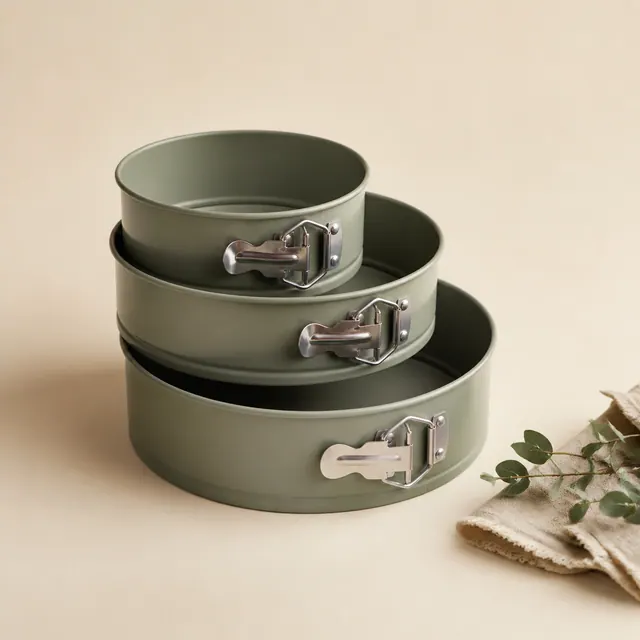
Change pans
Match batter fill depth where possible. A deeper cake does not bake in the same time.
Scale by usable batter volume, not nominal outside pan dimensions. Fill depth must leave the headroom required by the recipe.
If fill depth is unchanged, the ratio reduces to the area ratio. Baking temperature, time and structural limits are not scaled automatically.
Area & volume
Measure a single pan and the intended batter depth.
Round area = π × diameter² ÷ 4; rectangular area = length × width. One cubic centimetre equals one millilitre.
Worked example
The pre-filled example compares a 20 cm round pan with an identical 20 cm pan, so the area (π × 20² ÷ 4 ≈ 314.2 cm²) and scale factor of 1 are unchanged and 500 g of batter stays 500 g. Changing the new pan to a 23 cm square gives 529 cm² and a factor of about 1.68, so 500 g of batter becomes roughly 842 g at the same depth.
Pre-filled values: Change pans
Input
Value
Original pan shape
Round
Inside diameter
20 cm
Batter fill depth
4 cm
New pan shape
Round
Inside diameter
20 cm
Batter fill depth
4 cm
Original ingredient quantity
500 g
Calculated result
Result
Value
Original pan area
314.159 cm²
New pan area
314.159 cm²
Scale factor
1
Scaled ingredient quantity
500 g
New batter volume
1,256.637 ml
Reading the result
Scale by the inside dimensions of the pan and the depth you actually fill, not the size printed on the label.
A deeper cake needs a lower temperature or longer time; the calculator scales ingredients only.
Factors that are not round numbers are easiest to apply by weighing every ingredient.