Choose a cake pan by area, depth and material, and see how much more batter a larger or square pan holds, using worked area comparisons.
Area decides how much batter a pan holds
Pan area grows with the square of the diameter. A 20 cm round pan has an area of about 314 cm², while a 23 cm round pan has about 415 cm², 1.32 times as much. A 20 cm square pan has 400 cm², about 27% more than a 20 cm round pan. Scale the batter by that factor to keep the same depth: 500 g of batter for the 20 cm round becomes about 661 g for the 23 cm round.
Use internal dimensions
Nominal sizes may not reflect sloped sides or rounded corners. Measure across the inside of the base when precise scaling matters, and check the depth. A pan needs room for the cake to rise without spreading the batter into a thin layer.
Material and colour affect baking
Light-coloured aluminium heats evenly. Dark finishes can brown the edges faster, and glass and silicone behave differently again. Follow the recipe and the pan maker’s guidance, and check that the pan is rated for the oven temperature you will use.
Buy a small, versatile set
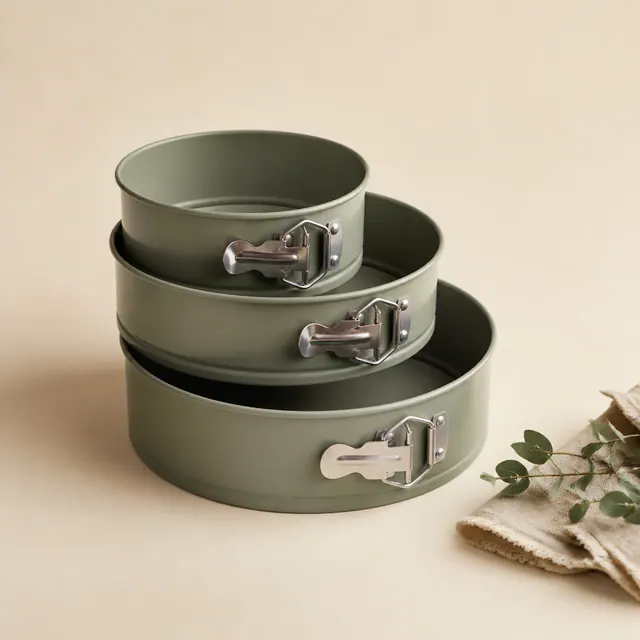
Choose sizes from the recipes you bake most often. A pair of matching straight-sided round pans covers many layer cakes. Add specialist shapes only for a recurring need, and check that the pans fit your oven shelf, cooling rack and storage.
Practical checklist
Avoid damaged non-stick surfaces.
Choose size markings that stay readable after washing.
Recheck baking time whenever batter depth changes.
Babushka Picks
A short list for the next step
Start with the essential item, add the useful option when it improves the job, and treat the final choice as optional.
Use the values and units in the worked example below; change the assumptions for your own project.
Pre-filled values: Change pans
Input
Value
Original pan shape
Round
Inside diameter
20 cm
Batter fill depth
4 cm
New pan shape
Round
Inside diameter
20 cm
Batter fill depth
4 cm
Original ingredient quantity
500 g
Calculated result
Result
Value
Original pan area
314.159 cm²
New pan area
314.159 cm²
Scale factor
1
Scaled ingredient quantity
500 g
New batter volume
1,256.637 ml
Questions and answers
How does How to Choose a Cake Pan work?
Match batter fill depth where possible. A deeper cake does not bake in the same time. Scale by usable batter volume, not nominal outside pan dimensions. Fill depth must leave the headroom required by the recipe. If fill depth is unchanged, the ratio reduces to the area ratio. Baking temperature, time and structural limits are not scaled automatically.
What does the worked example show?
Inputs: Original pan shape: Round; Inside diameter: 20 cm; Batter fill depth: 4 cm; New pan shape: Round; Inside diameter: 20 cm; Batter fill depth: 4 cm; Original ingredient quantity: 500 g. Result: Original pan area: 314.159 cm²; New pan area: 314.159 cm²; Scale factor: 1; Scaled ingredient quantity: 500 g; New batter volume: 1,256.637 ml.
What should I check before using the result?
If fill depth is unchanged, the ratio reduces to the area ratio. Baking temperature, time and structural limits are not scaled automatically.
Example from an existing calculator
Pan Size Converter | Babushka Market. This worked example demonstrates the calculation in the linked tool. Its displayed assumptions apply to that example; use the guidance above to decide which measurements, product specifications or quantities belong to your own task.
Worked example
With Original pan shape: Round; Inside diameter: 20 cm; Inside length: 25 cm; Inside width: 20 cm; Batter fill depth: 4 cm; New pan shape: Round; Inside diameter: 20 cm; Inside length: 25 cm; Inside width: 20 cm; Batter fill depth: 4 cm; Original ingredient quantity: 500 g, the calculator returns Original pan area: 314.159 cm².
Inputs
Inputs
Changed input
Original pan shape
Round
Inside diameter
20 cm
Inside length
25 cm
Inside width
20 cm
Batter fill depth
4 cm
New pan shape
Round
Inside diameter
20 cm
Inside length
25 cm
Inside width
20 cm
Batter fill depth
4 cm
Original ingredient quantity
500 g
Calculated result
Calculated result
Changed input
Original pan area
314.159 cm²
New pan area
314.159 cm²
Scale factor
1
Scaled ingredient quantity
500 g
New batter volume
1256.637 ml
Method and assumptions
Scale by usable batter volume, not nominal outside pan dimensions. Fill depth must leave the headroom required by the recipe. If fill depth is unchanged, the ratio reduces to the area ratio. Baking temperature, time and structural limits are not scaled automatically.
Common-value reference
The reference cases change only Inside diameter. The remaining inputs stay at the displayed values. These are worked scenarios, not universal rates, dimensions, product specifications or current shop prices.
Common-value reference
Inside diameter
Original pan area
Inside diameter: 20 cm
Original pan area: 314.159 cm²
Inside diameter: 10 cm
Original pan area: 78.54 cm²
Inside diameter: 30 cm
Original pan area: 706.858 cm²
Inside diameter: 40 cm
Original pan area: 1256.637 cm²
Inside diameter: 60 cm
Original pan area: 2827.433 cm²
Questions and answers
How is this example calculated?
Scale by usable batter volume, not nominal outside pan dimensions. Fill depth must leave the headroom required by the recipe. If fill depth is unchanged, the ratio reduces to the area ratio. Baking temperature, time and structural limits are not scaled automatically. In the displayed example, Original pan shape: Round; Inside diameter: 20 cm; Inside length: 25 cm; Inside width: 20 cm; Batter fill depth: 4 cm; New pan shape: Round; Inside diameter: 20 cm; Inside length: 25 cm; Inside width: 20 cm; Batter fill depth: 4 cm; Original ingredient quantity: 500 g. The calculated outputs are Original pan area: 314.159 cm²; New pan area: 314.159 cm²; Scale factor: 1; Scaled ingredient quantity: 500 g. Keep the labels and units with these numbers: they describe this particular combination of inputs, not a result that can be reused after the measurements or assumptions change.
What changes when I edit Inside diameter?
The table isolates that input while keeping the other displayed settings fixed. For Inside diameter: 10 cm, the result is Original pan area: 78.54 cm²; for Inside diameter: 60 cm, it is Original pan area: 2827.433 cm². Those values come from the same calculator used on this page. They show the effect of changing the input, rather than prescribing which input is right for your own task.
How should I use the different result figures?
Read each named quantity separately: Original pan area: 314.159 cm²; New pan area: 314.159 cm²; Scale factor: 1; Scaled ingredient quantity: 500 g. A value with a different label or unit answers a different part of the calculation. Check the measurements and assumptions before using any figure. The reference cases explain the arithmetic under their stated conditions; they do not verify a product label, a recipe or the conditions of a particular project.