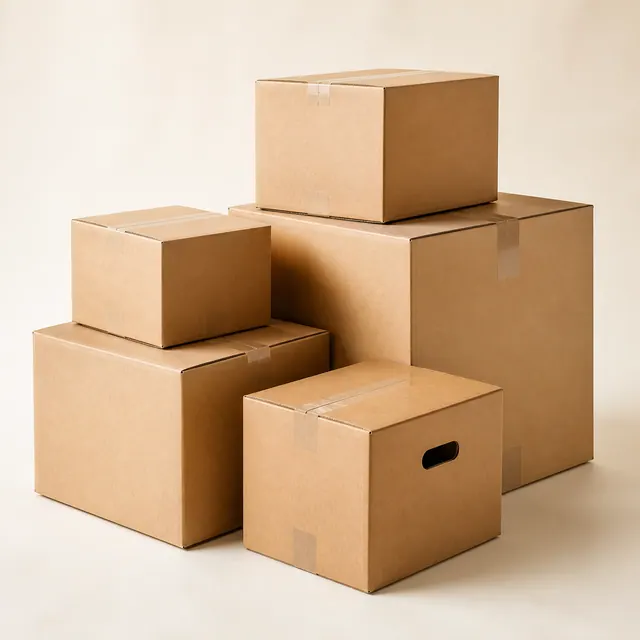
Plan box sizes and packing tape from measured or estimated contents volume.
What does a worked calculation look like?
Packing 0.3 m³ into 30 L small boxes, 0.8 m³ into 60 L medium boxes and 0.6 m³ into 90 L large boxes, with a 10% allowance, gives 11 small, 15 medium and 8 large boxes: 34 in total. At 3 m of tape per box, that is 3 rolls of 50 m.
Method and practical checks
Volume estimates include packing material. Do not fill a large box with heavy items simply because the volume fits. Check box weight limits.
As an Amazon Associate I earn from qualifying purchases.
How the Moving Box Planner works
Every calculation option
By contents volume
Estimate packed contents volume for each box size; exclude furniture that will not be boxed.
Volume estimates include packing material. Do not fill a large box with heavy items simply because the volume fits. Check box weight limits.
Quick estimate
Use a rough count before you have measured your contents.
Room rates are editable examples, not a survey-based prediction. Refine the estimate with a room-by-room packing inventory.
Worked example
Packing 0.3 m³ into 30 L small boxes, 0.8 m³ into 60 L medium boxes and 0.6 m³ into 90 L large boxes, with a 10% allowance, gives 11 small, 15 medium and 8 large boxes: 34 in total. At 3 m of tape per box, that is 3 rolls of 50 m.
Pre-filled values: By contents volume
Input
Value
Heavy items volume
0.3 m³
General items volume
0.8 m³
Light items volume
0.6 m³
Small box capacity
30 L
Medium box capacity
60 L
Large box capacity
90 L
Extra allowance
10 %
Tape per box
3 m
Tape roll length
50 m
Calculated result
Result
Value
Small boxes
11
Medium boxes
15
Large boxes
8
Total boxes
34
Tape rolls
3
Reading the result
Put books and heavy items in small boxes even if they would fit in large ones; weight limits matter more than volume.
The quick room estimate is an editable starting point. A cupboard-by-cupboard volume estimate is more reliable.
Furniture, mattresses and appliances are not boxed and are not included.
The worked volume example needs 34 boxes: 11 small, 15 medium and eight large. It uses 0.3, 0.8 and 0.6 m³ of contents, box capacities of 30, 60 and 90 L, and a 10% allowance. Your inventory and each box's usable capacity change the answer.
Can I estimate boxes from rooms instead?
Yes, but the room rates are editable assumptions. Three rooms at eight boxes each plus two people at five each give 34 boxes before allowance, or 38 with 10%. A library, full loft or workshop can differ greatly from an average room, so refine the estimate with an inventory.
Which moving box size should I choose?
Put dense contents such as books in small boxes and light bulky contents such as bedding in larger boxes. The calculator separates those volumes for that reason. A box's volume does not establish a safe packed weight: follow the manufacturer's load guidance and your handling limits.
How much packing tape does the example need?
At an assumed three metres per box, 34 boxes require 102 m of tape. Fifty-metre rolls round up to three rolls. Change the tape-per-box and roll-length inputs for your closure method and product; the result is a quantity estimate, not a test of the tape's strength.
Calculation/content reviewed 4 October 2026. Source: Babushka Market’s displayed formulas, units and labelled editable assumptions. How the estimates work