Method and assumptions
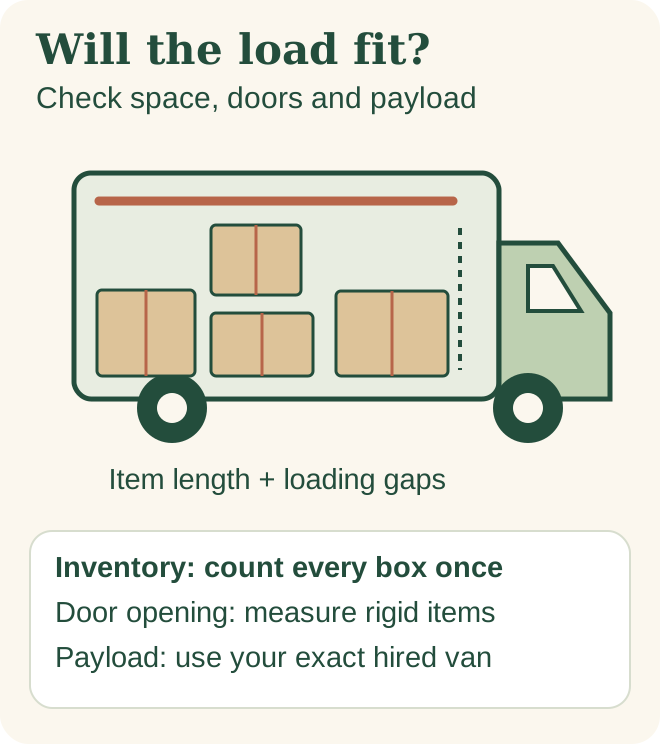
Measure each item’s outside length, width and height in centimetres. Enter the item count; the sum is its bounding volume, not proof that every shape can be loaded without gaps. Include packed boxes only once.
Ford lists Transit Custom L1H1 at 5.8 m³ and L2H1 at 6.8 m³ with a bulkhead. Renault’s UK Master variants list 10.8, 13 and 14.8 m³. Confirm the actual model year, roof, bulkhead and drive configuration with the hire company.
The loading fraction, available payload and door opening are user inputs. Volume trips and weight trips are calculated separately; the higher count is the lower planning bound. Door fit and awkward shapes can require a different vehicle despite that arithmetic.
Removal-industry household ranges include furniture: studio 5–10 m³, one-to-two-bedroom 10–20, three-bedroom 20–30, and larger household 30–50+. They are broad provider guidance, not a precise prediction for your home. Prefer your measured inventory.
Related tools
Worked example
With Packed box EXTERIOR volume (m³): 2; Confirmed cargo volume (m³): 5.8; Practical loading (%): 80; Inventory weight (kg): 600; Available payload (kg): 1000; Door width (cm): 130; Door height (cm): 150, the calculator returns Calculated result: 1 trip.
| Inputs | Changed input |
|---|---|
| Packed box EXTERIOR volume (m³) | 2 |
| Confirmed cargo volume (m³) | 5.8 |
| Practical loading (%) | 80 |
| Inventory weight (kg) | 600 |
| Available payload (kg) | 1000 |
| Door width (cm) | 130 |
| Door height (cm) | 150 |
| Calculated result | Changed input |
|---|---|
| Calculated result | 1 trip |
| By volume / payload | 1 / 1 trips |
| Payload | 1,000 kg |
| Loading assumption | 80% |
Method and assumptions
Measure each item’s outside length, width and height in centimetres. Enter the item count; the sum is its bounding volume, not proof that every shape can be loaded without gaps. Include packed boxes only once. Ford lists Transit Custom L1H1 at 5.8 m³ and L2H1 at 6.8 m³ with a bulkhead. Renault’s UK Master variants list 10.8, 13 and 14.8 m³. Confirm the actual model year, roof, bulkhead and drive configuration with the hire company. The loading fraction, available payload and door opening are user inputs. Volume trips and weight trips are calculated separately; the higher count is the lower planning bound. Door fit and awkward shapes can require a different vehicle despite that arithmetic. Removal-industry household ranges include furniture: studio 5–10 m³, one-to-two-bedroom 10–20, three-bedroom 20–30, and larger household 30–50+. They are broad provider guidance, not a precise prediction for your home. Prefer your measured inventory.
Common-value reference
The reference cases change only Packed box EXTERIOR volume (m³). The remaining inputs stay at the displayed values. These are worked scenarios, not universal rates, dimensions, product specifications or current shop prices.
| Packed box EXTERIOR volume (m³) | Calculated result |
|---|---|
| Packed box EXTERIOR volume (m³): 2 | Calculated result: 1 trip |
| Packed box EXTERIOR volume (m³): 1 | Calculated result: 1 trip |
| Packed box EXTERIOR volume (m³): 3 | Calculated result: 2 trips |
| Packed box EXTERIOR volume (m³): 4 | Calculated result: 2 trips |
| Packed box EXTERIOR volume (m³): 6 | Calculated result: 2 trips |
Questions and answers
How is this example calculated?
Measure each item’s outside length, width and height in centimetres. Enter the item count; the sum is its bounding volume, not proof that every shape can be loaded without gaps. Include packed boxes only once. Ford lists Transit Custom L1H1 at 5.8 m³ and L2H1 at 6.8 m³ with a bulkhead. Renault’s UK Master variants list 10.8, 13 and 14.8 m³. Confirm the actual model year, roof, bulkhead and drive configuration with the hire company. The loading fraction, available payload and door opening are user inputs. Volume trips and weight trips are calculated separately; the higher count is the lower planning bound. Door fit and awkward shapes can require a different vehicle despite that arithmetic. Removal-industry household ranges include furniture: studio 5–10 m³, one-to-two-bedroom 10–20, three-bedroom 20–30, and larger household 30–50+. They are broad provider guidance, not a precise prediction for your home. Prefer your measured inventory. In the displayed example, Packed box EXTERIOR volume (m³): 2; Confirmed cargo volume (m³): 5.8; Practical loading (%): 80; Inventory weight (kg): 600; Available payload (kg): 1000; Door width (cm): 130; Door height (cm): 150. The calculated outputs are Calculated result: 1 trip; By volume / payload: 1 / 1 trips; Payload: 1,000 kg; Loading assumption: 80%. Keep the labels and units with these numbers: they describe this particular combination of inputs, not a result that can be reused after the measurements or assumptions change.
What changes when I edit Packed box EXTERIOR volume (m³)?
The table isolates that input while keeping the other displayed settings fixed. For Packed box EXTERIOR volume (m³): 1, the result is Calculated result: 1 trip; for Packed box EXTERIOR volume (m³): 6, it is Calculated result: 2 trips. Those values come from the same calculator used on this page. They show the effect of changing the input, rather than prescribing which input is right for your own task.
How should I use the different result figures?
Read each named quantity separately: Calculated result: 1 trip; By volume / payload: 1 / 1 trips; Payload: 1,000 kg; Loading assumption: 80%. A value with a different label or unit answers a different part of the calculation. Check the measurements and assumptions before using any figure. The reference cases explain the arithmetic under their stated conditions; they do not verify a product label, a recipe or the conditions of a particular project.