Formula
- Floor area = room length × room width.
- Area to buy = floor area × (1 + allowance ÷ 100); packs = area to buy ÷ coverage per pack, rounded up.
Assumptions and limits
- Packs round up to whole packs.

Home & DIY calculator
Key fact: Floor area (m²): 20; Area including cutting allowance (m²): 22; Packs to buy: 10 (Room length: 5 m; Room width: 4 m; Coverage per pack: 2.2 m²; Waste: 10 %). Worked example from this calculator's default values, updated 26 November 2026.
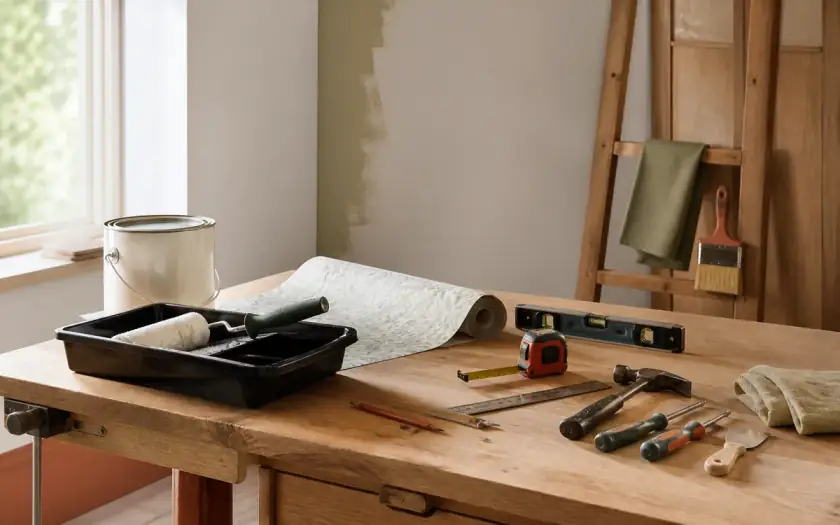
A 5 × 4 m room has 20 m² of floor. With a 10% cutting allowance you need 22 m², and packs covering 2.2 m² each mean exactly 10 packs.
Example with the pre-filled values
Ready when you are
Your answer and the practical quantities behind it will appear here.
Saved on this device
Your latest calculations will appear here on this device.
Amazon
| Input | Value |
|---|---|
| Room length | 5 m |
| Room width | 4 m |
| Coverage per pack | 2.2 m² |
| Waste | 10 % |
| Result | Value |
|---|---|
| Floor area (m²) | 20 |
| Area including cutting allowance (m²) | 22 |
| Packs to buy | 10 |
With Room length: 5 m; Room width: 4 m; Coverage per pack: 2.2 m²; Waste: 10 %, the calculator returns Floor area (m²): 20.
| Inputs | Changed input |
|---|---|
| Room length | 5 m |
| Room width | 4 m |
| Coverage per pack | 2.2 m² |
| Waste | 10 % |
| Calculated result | Changed input |
|---|---|
| Floor area (m²) | 20 |
| Area including cutting allowance (m²) | 22 |
| Packs to buy | 10 |
Packs round up to whole packs.
The reference cases change only Room length. The remaining inputs stay at the displayed values. These are worked scenarios, not universal rates, dimensions, product specifications or current shop prices.
| Room length | Floor area (m²) |
|---|---|
| Room length: 5 m | Floor area (m²): 20 |
| Room length: 2.5 m | Floor area (m²): 10 |
| Room length: 7.5 m | Floor area (m²): 30 |
| Room length: 10 m | Floor area (m²): 40 |
| Room length: 15 m | Floor area (m²): 60 |
Packs round up to whole packs. In the displayed example, Room length: 5 m; Room width: 4 m; Coverage per pack: 2.2 m²; Waste: 10 %. The calculated outputs are Floor area (m²): 20; Area including cutting allowance (m²): 22; Packs to buy: 10. Keep the labels and units with these numbers: they describe this particular combination of inputs, not a result that can be reused after the measurements or assumptions change.
The table isolates that input while keeping the other displayed settings fixed. For Room length: 2.5 m, the result is Floor area (m²): 10; for Room length: 15 m, it is Floor area (m²): 60. Those values come from the same calculator used on this page. They show the effect of changing the input, rather than prescribing which input is right for your own task.
Read each named quantity separately: Floor area (m²): 20; Area including cutting allowance (m²): 22; Packs to buy: 10. A value with a different label or unit answers a different part of the calculation. Check the measurements and assumptions before using any figure. The reference cases explain the arithmetic under their stated conditions; they do not verify a product label, a recipe or the conditions of a particular project.
Calculate the measured area and allowance first, then round up to complete packs using the printed pack coverage. Rounding each measurement early can compound errors. Keep a separate plan for underlay, trims and thresholds because their pack sizes and waste differ from the flooring.
Area establishes a starting quantity, but the cutting plan affects waste. Narrow end pieces, diagonal layouts and patterns can use more material. The waste percentage is editable; compare the result with the supplier's installation instructions and your room-by-room layout. Plan diagonal cuts explicitly.
Treat the difference between purchased pack coverage and planned coverage as a separately reported remainder. Some may cover cuts or later repairs, but it is not automatically all waste. Check batch consistency and storage needs before ordering; pack rounding describes a purchase quantity rather than a complete installation layout.
Calculation/content reviewed 4 October 2026. Source: Babushka Market’s displayed formulas, units and labelled editable assumptions. How the estimates work