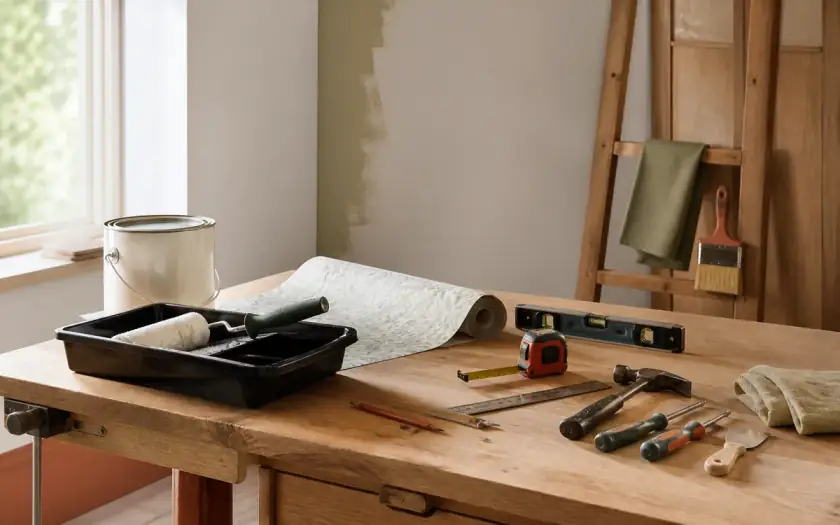
When bare, new, repaired, stained or strongly contrasting surfaces need a primer or mist coat, and when a sound painted wall only needs cleaning.
Sound, previously painted walls
A wall already painted with a sound, compatible finish usually needs cleaning, filling and light sanding rather than a separate primer. Check whether the new paint’s instructions require anything more for the existing finish.
New plaster
Dulux advises that new plaster can take up to four weeks to dry completely, and that emulsion applied to wet plaster is likely to crack and peel. Its guidance for the first coat is a mist coat of white emulsion thinned at about ten parts paint to one part water, or a dedicated plaster sealer. Follow the instructions of the paint you are actually using, since some products specify a different sealer.
Bare wood, metal, repairs and stains
Bare timber, metal and masonry need a primer made for that material. Filled patches and porous repairs absorb paint differently from the surrounding wall and can show through as dull spots. Water marks, smoke and other stains need a stain-blocking product. Do not paint over dampness or an unresolved leak; fix the cause first.
Large colour changes
Going from a very dark colour to a light one, or the reverse, can need an extra coat. Some makers recommend a tinted undercoat for this. Primer and undercoat are separate from the finish coats you enter in the paint calculator.
Practical checklist
Spot-prime repairs only where the product system allows it.
Let each coat dry for the time stated on the tin before recoating.
Keep the primer’s own coverage figure separate from the finish paint’s.
Use the values and units in the worked example below; change the assumptions for your own project.
Pre-filled values: Walls
Input
Value
Walls
Length 5 m, Height 2.5 m, Number of walls 2 · Length 4 m, Height 2.5 m, Number of walls 2
Total measured openings
4.7 m²
Coats
2
Coverage per coat
10 m²/L
Extra allowance
10 %
Pack size
2.5 L
Calculated result
Result
Value
Paintable area
40.3 m²
Paint before allowance
8.06 L
Required quantity
8.866 L
Packs to buy
4
Purchase quantity
10 L
Left over
1.134 L
Questions and answers
How does Do I Need Primer Before Painting? work?
Enter different wall lengths, then choose the paint and tin size. Litres = net wall area × coats ÷ coverage, then add the chosen allowance. Tin counts round up; primer and finish coats need separate plans.
What does the worked example show?
Inputs: Walls: Length 5 m, Height 2.5 m, Number of walls 2 · Length 4 m, Height 2.5 m, Number of walls 2; Total measured openings: 4.7 m²; Coats: 2; Coverage per coat: 10 m²/L; Extra allowance: 10 %; Pack size: 2.5 L. Result: Paintable area: 40.3 m²; Paint before allowance: 8.06 L; Required quantity: 8.866 L; Packs to buy: 4; Purchase quantity: 10 L; Left over: 1.134 L.
What should I check before using the result?
Litres = net wall area × coats ÷ coverage, then add the chosen allowance. Tin counts round up; primer and finish coats need separate plans.
Example from an existing calculator
Wall Paint Calculator | Babushka Market. This worked example demonstrates the calculation in the linked tool. Its displayed assumptions apply to that example; use the guidance above to decide which measurements, product specifications or quantities belong to your own task.
Worked example
With Length: 5 m; Height: 2.5 m; Number of walls: 2; Length: 4 m; Height: 2.5 m; Number of walls: 2; Total measured openings: 4.7 m²; Coats: 2; Coverage per coat: 10 m²/L; Extra allowance: 10 %; Pack size: 2.5 L, the calculator returns Paintable area: 40.3 m².
Inputs
Inputs
Changed input
Length
5 m
Height
2.5 m
Number of walls
2
Length
4 m
Height
2.5 m
Number of walls
2
Total measured openings
4.7 m²
Coats
2
Coverage per coat
10 m²/L
Extra allowance
10 %
Pack size
2.5 L
Calculated result
Calculated result
Changed input
Paintable area
40.3 m²
Paint before allowance
8.06 L
Required quantity
8.866 L
Packs to buy
4
Purchase quantity
10 L
Left over
1.134 L
Method and assumptions
Litres = net wall area × coats ÷ coverage, then add the chosen allowance. Tin counts round up; primer and finish coats need separate plans.
Common-value reference
The reference cases change only Total measured openings. The remaining inputs stay at the displayed values. These are worked scenarios, not universal rates, dimensions, product specifications or current shop prices.
Common-value reference
Total measured openings
Paintable area
Total measured openings: 4.7 m²
Paintable area: 40.3 m²
Total measured openings: 2.35 m²
Paintable area: 42.65 m²
Total measured openings: 7.05 m²
Paintable area: 37.95 m²
Total measured openings: 9.4 m²
Paintable area: 35.6 m²
Total measured openings: 14.1 m²
Paintable area: 30.9 m²
Questions and answers
How is this example calculated?
Litres = net wall area × coats ÷ coverage, then add the chosen allowance. Tin counts round up; primer and finish coats need separate plans. In the displayed example, Length: 5 m; Height: 2.5 m; Number of walls: 2; Length: 4 m; Height: 2.5 m; Number of walls: 2; Total measured openings: 4.7 m²; Coats: 2; Coverage per coat: 10 m²/L; Extra allowance: 10 %; Pack size: 2.5 L. The calculated outputs are Paintable area: 40.3 m²; Paint before allowance: 8.06 L; Required quantity: 8.866 L; Packs to buy: 4. Keep the labels and units with these numbers: they describe this particular combination of inputs, not a result that can be reused after the measurements or assumptions change.
What changes when I edit Total measured openings?
The table isolates that input while keeping the other displayed settings fixed. For Total measured openings: 2.35 m², the result is Paintable area: 42.65 m²; for Total measured openings: 14.1 m², it is Paintable area: 30.9 m². Those values come from the same calculator used on this page. They show the effect of changing the input, rather than prescribing which input is right for your own task.
How should I use the different result figures?
Read each named quantity separately: Paintable area: 40.3 m²; Paint before allowance: 8.06 L; Required quantity: 8.866 L; Packs to buy: 4. A value with a different label or unit answers a different part of the calculation. Check the measurements and assumptions before using any figure. The reference cases explain the arithmetic under their stated conditions; they do not verify a product label, a recipe or the conditions of a particular project.